
Can Hail Damage Be Repaired Without Repainting Your Car? A Colorado Driver's Guide

Colorado hailstorms can leave a vehicle covered in dents within minutes. From small dings on the hood to more noticeable damage across the roof, trunk, and doors, hail can significantly affect a vehicle's appearance.

For drivers in Sheridan, Denver, Englewood, Littleton, and surrounding Colorado communities, one question often comes up after a storm:
Can hail damage be repaired without repainting the car?
The short answer is yes. Many hail dents can be repaired without repainting through a technique called paintless dent repair (PDR), provided the original paint remains intact and the damage is suitable for the process. However, dents involving cracked paint, severe metal deformation, or difficult panel locations may require traditional auto body repair and refinishing.
Understanding these differences can help you make informed decisions about restoring your vehicle.
At Ed's Auto Body, located at 2331 W Hampden Ave, Unit 173, in Sheridan, Colorado, we believe drivers should understand their repair options before moving forward with any vehicle restoration.
Why Hail Damage Is a Serious Concern for Colorado Drivers
Colorado's Front Range is well known for severe thunderstorms and damaging hail.
Communities throughout the Denver metropolitan area experience hailstorms capable of damaging vehicles, residential properties, and commercial buildings.
According to the National Weather Service, Colorado's Front Range experiences significant severe-weather activity, including thunderstorms capable of producing large hail.
For vehicle owners, the severity of hail damage depends on several factors, including hailstone size, wind conditions, vehicle exposure, and the location of the impacts.
A vehicle parked outdoors during a storm may sustain damage to several areas simultaneously.
Commonly affected components include:
Hoods and roofs
Trunk lids
Doors and quarter panels
Fenders
Exterior trim
Windshields and other glass
Even when hail damage appears minor, a closer inspection may reveal additional dents that are difficult to see under ordinary lighting.
For drivers around Sheridan, Englewood, Littleton, Lakewood, and Denver, understanding the available repair methods is an important first step toward restoring a hail-damaged vehicle.
What Is Paintless Dent Repair?
Paintless dent repair, commonly abbreviated as PDR, is a specialized technique used to remove certain dents without sanding, applying body filler, or repainting the affected panel.
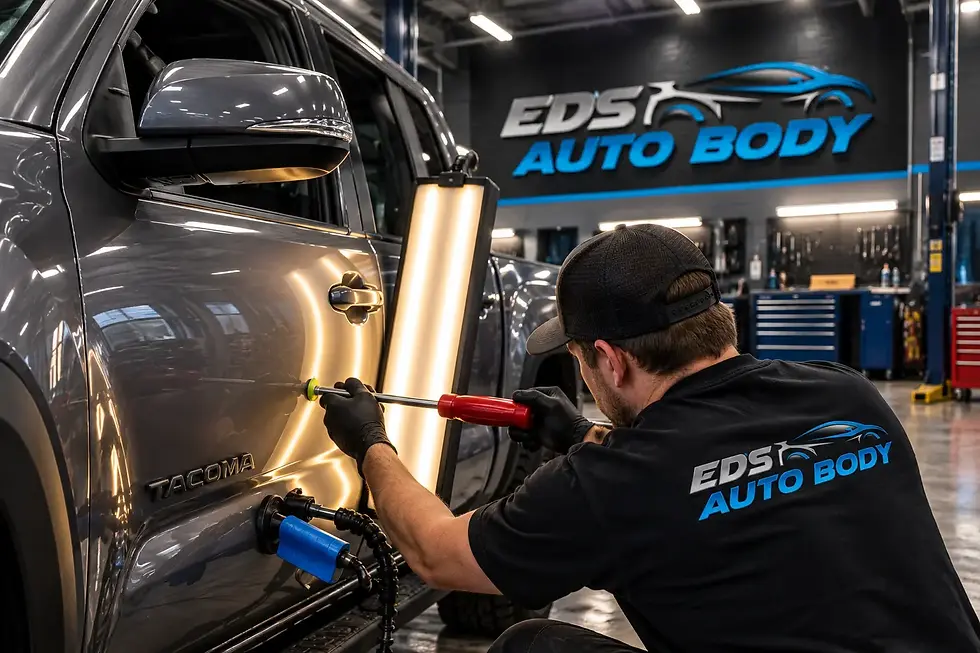
Instead of replacing the vehicle's original finish, technicians carefully manipulate the damaged metal toward its original shape using specialized tools and techniques.
Depending on the location and characteristics of the dent, a technician may work from behind the panel or use other appropriate PDR methods.
The objective is to restore the panel's appearance while preserving its existing painted surface.
The American Automobile Association (AAA) identifies paintless dent repair as a common technique for correcting suitable hail dents without disturbing the vehicle's paint.
However, not every dent qualifies for this method.
The success and suitability of PDR depend on the condition of the paint, the shape and depth of the damage, panel construction, and accessibility.
When Can Hail Damage Be Repaired Without Repainting?
Several factors help determine whether a hail-damaged vehicle is a good candidate for paintless dent repair.
1. The Original Paint Remains Intact
One of the most important considerations is whether the hail impact damaged the vehicle's finish. If the paint remains intact and the dent is suitable for PDR, a technician may be able to reshape the affected metal without repainting. This can help preserve the vehicle's existing finish.
However, if hail has caused cracking, chipping, or other paint damage, additional repair work may be necessary.
2. The Dent Is Suitable for Metal Reshaping
Hail dents vary considerably.
Some are shallow and rounded, while others are sharp, deep, or positioned along complex body contours. Broad, shallow dents with intact paint may be suitable for PDR, while sharper impacts can be more difficult to correct. A technician must evaluate the individual dent rather than relying on its diameter alone.
3. The Damaged Area Can Be Accessed
The location of the dent also influences the repair process.
Some vehicle panels allow technicians to reach the damaged metal from behind, while others contain reinforcements, structural components, or limited-access areas.
Panel design can affect the techniques available. Even when a dent appears relatively small, its location may make the repair more complex.
4. The Panel Material and Condition Are Appropriate
Modern vehicles may use steel, aluminum, plastics, and other materials throughout their exterior construction. Different materials have different repair characteristics.
Previous repairs, existing paint damage, and the overall condition of a panel can also influence whether PDR is appropriate. This is why professional damage evaluation matters.
When Does Hail Damage Require Traditional Auto Body Repair?
Although paintless dent repair is useful for many hail-related dents, some damage requires a different approach. Traditional auto body repair may be necessary when the original finish is compromised or the panel cannot be adequately restored through PDR.
Cracked or Chipped Paint
Hail impacts can sometimes crack or chip the paint surrounding a dent.
When the protective finish has been damaged, simply removing the dent may not fully address the problem. Depending on the damage, surface preparation and refinishing may be required.
AAA notes that hail-related paint damage may need conventional refinishing to help protect the affected area.
Deep or Sharp Dents
Severe hail impacts can create sharp depressions or stretch the affected metal.
These characteristics may limit the effectiveness of PDR.
Traditional body repair may be required to properly restore the panel.
Damage Along Body Lines
Modern vehicles often feature pronounced body lines and complex panel contours.
Hail impacts in these areas can present additional repair challenges. The appropriate technique depends on the location, shape, and severity of the damage.
Severely Damaged Panels
Some storms produce damage extensive enough to require panel replacement or other conventional repairs. A professional inspection helps determine whether repairing or replacing an affected component is appropriate.
Paintless Dent Repair vs. Traditional Dent Repair: What's the Difference?
Both methods have an important role in automotive restoration.
Repair consideration | Paintless dent repair | Traditional body repair |
Original paint | Usually preserved | May require refinishing |
Best suited for | Suitable dents with intact paint | More extensive damage or damaged paint |
Body filler | Generally not required | May be used when appropriate |
Panel replacement | Usually unnecessary for suitable dents | Sometimes necessary |
Repair timeline | Depends on dent count and complexity | Depends on damage and repair procedures |
Primary objective | Restore suitable dents without repainting | Restore damage requiring conventional repair |
Neither method is automatically superior. The correct approach depends on the condition of the vehicle. For example, a vehicle may have several dents suitable for PDR while another panel requires conventional repair because its paint has been damaged.
In those situations, a combination of techniques may be appropriate.
Can Large Hail Dents Be Repaired Without Painting?
Some larger dents can be repaired without repainting, but size alone does not determine whether PDR will work. A broad dent with intact paint may be more suitable for PDR than a smaller dent with a sharp crease or cracked finish.
Technicians consider multiple factors, including:
Dent diameter and depth
Metal deformation
Paint condition
Panel material
Location near edges or body lines
Previous repairs
Access to the affected area
Rather than assuming a large dent requires repainting, it is better to have the vehicle evaluated.
Can Hail Damage on Aluminum Panels Be Repaired?
Yes, some hail dents in aluminum panels can be repaired using paintless dent repair.
However, aluminum behaves differently from steel, and repair suitability depends on the panel and damage characteristics.
Certain aluminum panels may require specialized tools, techniques, or additional repair considerations. Because vehicle construction varies by manufacturer and model, technicians should assess the specific panel before recommending a repair process. This is particularly important for modern trucks, SUVs, luxury vehicles, and sports cars that may incorporate different exterior materials.
Will Paintless Dent Repair Preserve the Factory Finish?
One of the primary advantages of PDR is that it is designed to preserve the existing painted surface when the damage qualifies. Modern automotive finishes can involve multiple layers, including primer, basecoat, and clearcoat. Conventional refinishing requires careful preparation and application to restore a damaged finish.
When PDR is appropriate, technicians can avoid refinishing the affected area altogether.
However, preserving the original finish should never take priority over completing the repair correctly. If the paint is cracked or damaged, additional refinishing may be necessary.
Does Hail Damage Affect a Vehicle's Resale Value?
Hail damage can affect a vehicle's appearance and may influence its resale or trade-in value. Buyers and dealerships often consider the condition of exterior panels when evaluating a vehicle. Even relatively minor cosmetic damage may affect how a vehicle is perceived.
The impact on value depends on factors such as:
Vehicle age and condition
Severity of the damage
Repair history
Quality of completed repairs
Market conditions
Repairing hail damage may improve the vehicle's appearance, but no repair method can guarantee a particular resale value. For drivers planning to sell or trade in their vehicles, documenting the damage and any completed repairs can be useful.
Should You Repair Minor Hail Damage?
A few small dents may not seem urgent, especially when the vehicle remains drivable and the paint appears intact. However, it is worth understanding the full extent of the damage before deciding to leave it untreated. Hail dents can be difficult to identify under normal lighting. Professional repair evaluations may use specialized lighting to highlight subtle variations in the metal surface. This can reveal damage across areas that initially appeared unaffected.
If hail has also chipped or cracked the paint, delaying appropriate repairs could allow exposed areas to deteriorate. The decision to repair cosmetic damage depends on your priorities, but identifying the complete damage is a sensible starting point.
Does Car Insurance Cover Paintless Dent Repair for Hail Damage?
Hail damage is generally covered under the comprehensive portion of an auto insurance policy when that coverage is included and the claim meets the policy's terms.
According to the Insurance Information Institute, comprehensive coverage generally addresses damage from events other than collisions, including hail.
However, coverage varies by policy.
Drivers should review their deductibles, coverage limits, exclusions, and claim requirements with their insurance provider. Whether the repair involves PDR, conventional body repair, or both depends on the vehicle's damage and the applicable repair plan.
For additional information about insurance-related repair choices, read our guide:
When publishing, link this text directly to that article's individual URL rather than the blog listing page.
Should You Do After a Colorado Hailstorm?
If your vehicle has been exposed to damaging hail, begin by inspecting it once conditions are safe.
Document the Damage
Take photographs of visible dents, paint damage, and broken glass.
Capture several angles and include images of the entire vehicle.
Check More Than the Hood
Hail damage frequently affects multiple exterior surfaces.
Inspect the roof, trunk, doors, fenders, quarter panels, and glass.
Avoid Unproven DIY Dent Removal Methods
Online videos sometimes recommend household tools, extreme temperature changes, or improvised suction devices to remove dents. These methods can damage the finish or make repairs more difficult. Professional techniques are designed around the characteristics of the panel and the damage.
Review Your Insurance Coverage
If you plan to use insurance, review your policy and follow your insurer's claim procedures.
Schedule a Professional Inspection
A qualified auto body repair shop can evaluate the damage and explain whether PDR, traditional repair, or a combination of methods is appropriate.
Hail Damage Repair Near Sheridan, Denver, and Surrounding Communities
Ed's Auto Body is located at 2331 W Hampden Ave, Unit 173, Sheridan, CO 80110, in the southwest Denver metropolitan area.
Our Sheridan location provides a convenient point of contact for drivers seeking auto body and hail damage evaluations from surrounding communities, including:
Sheridan and Englewood
Littleton and Bow Mar
Denver and Lakewood
Centennial and Highlands Ranch
Greenwood Village
Wheat Ridge and Arvada
Other nearby Front Range communities
Whether your vehicle sustained several minor dents or more extensive exterior damage, the first step is understanding the condition of the affected panels.
An appropriate repair recommendation should be based on the actual damage rather than a one-size-fits-all approach.
Frequently Asked Questions About Hail Dent Repair
Can hail dents be removed without repainting?
Yes. Many hail dents can be repaired without repainting using paintless dent repair, provided the paint remains intact and the damage is suitable for the technique.
Is paintless dent repair permanent?
When a dent is properly repaired, the corrected metal does not ordinarily return to its dented shape on its own. However, the panel can still sustain new damage from future impacts.
Does PDR work on every vehicle?
PDR can be used on many vehicles, but suitability depends on panel material, damage characteristics, paint condition, and accessibility.
Can hail damage be repaired on a car roof?
Yes. Certain roof dents may qualify for PDR. Repair complexity depends on roof construction, access, damage severity, and vehicle-specific requirements.
Is paintless dent repair cheaper than traditional body repair?
PDR can be less expensive for suitable damage because it may avoid refinishing materials and associated labor. However, total cost depends on dent quantity, complexity, location, and the repair procedures required.
How long does hail dent repair take?
Repair time varies based on the number of dents, severity, access requirements, parts needs, and shop scheduling. A professional inspection is needed for a meaningful estimate.
Can hail damage cause paint problems later?
If the original finish was cracked or chipped during the storm, exposed areas may become vulnerable to deterioration. Intact paint over a properly repaired dent does not automatically require refinishing.
Where can I get hail damage evaluated near Sheridan, Colorado?
Drivers can contact Ed's Auto Body at 2331 W Hampden Ave, Unit 173, Sheridan, CO 80110, to discuss vehicle damage and available inspection options.
Choosing the Right Hail Damage Repair Method for Your Vehicle
Hail damage does not automatically mean your vehicle needs a new paint job.
Many dents can be repaired using paintless dent repair when the original finish remains intact and the panel is suitable for the technique. Other damage may require conventional auto body repair, refinishing, or replacement of affected components.
For Colorado drivers, the most important step is understanding the actual condition of the vehicle before choosing a repair method.
At Ed's Auto Body, we believe clear communication and careful damage evaluation are essential parts of the repair experience.

Need Hail Damage or Dent Repair Near Sheridan, Colorado?
If a recent hailstorm left your vehicle with dents, damaged paint, or other exterior damage, Ed's Auto Body is here to help you understand your repair options.
Located in Sheridan, we welcome inquiries from drivers throughout Denver, Englewood, Littleton, Lakewood, Centennial, Highlands Ranch, and surrounding communities.
Whether your vehicle needs minor dent repair or more extensive auto body restoration, the next step is determining which repairs are appropriate for your vehicle.
Ready to get started?
Ed's Auto Body 2331 W Hampden Ave, Unit 173Sheridan, CO 80110
Phone: (720) 769-5547
Professional auto body repair starts with understanding the damage—and choosing the right solution for your vehicle.

Comments